
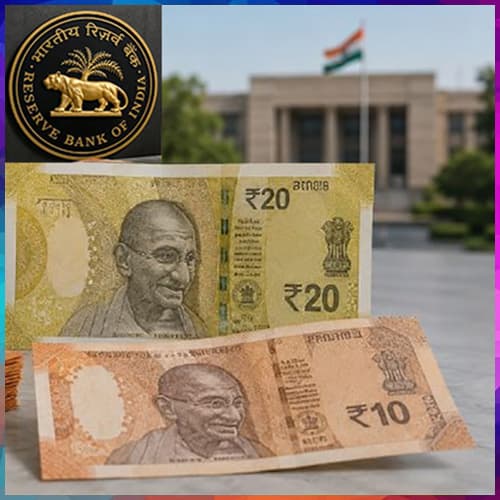
India could be approaching an interesting convergence between currency innovation and domestic polymer manufacturing. The government has approved the Reserve Bank of India’s proposal to field-test one billion ₹10 and one billion ₹20 polymer banknotes. RBI Governor Sanjay Malhotra has subsequently said the central bank is targeting introduction from FY28, subject to successful trials and operational assessment.
Key Highlights
- 2 billion polymer notes proposed for RBI field trials.
- ₹10 and ₹20 denominations lead the experiment.
- BOPP, not PVC, is the relevant banknote polymer.
- Adani PVC: 1 MTPA initially, expandable to 2 MTPA.
- Future opportunity: domestic security-grade polymer manufacturing and recycling.
The development creates a new opportunity for India’s specialty-polymer ecosystem. Polymer banknotes require security-grade polymer substrate, generally based on biaxially oriented polypropylene (BOPP), combined with specialised opacification, coatings, printing and security features. RBI subsidiary BRBNMPL has already sought suppliers for security-grade polymer substrates, while recent reports indicate Indian and international companies have submitted bids.
The economic proposition is durability. RBI has told the government that international evidence indicates polymer notes have significantly longer lives than conventional paper notes. Lower denominations are particularly relevant because their high circulation means faster deterioration. However, RBI intends polymer and existing paper notes to coexist, rather than immediately replacing India's paper currency.
At approximately the same time, Adani is building a major polymer-related manufacturing ecosystem at Mundra. Its current project is a 1-MTPA PVC facility with expansion capability to 2 MTPA, addressing an Indian PVC market where FY2025-26 demand was about 4.55 MMT against only 1.6 MMT of domestic capacity. Adani expects the project to be operationalised in FY2028-29.
There is, however, an important distinction. Adani’s announced Mundra project produces PVC, whereas banknote substrate requires BOPP/polypropylene. Therefore, RBI’s initiative does not directly create demand for Adani's currently announced PVC output. There is also no public evidence at present that Adani will manufacture security-grade BOPP for RBI.
The strategic opportunity is nevertheless intriguing. If polymer currency scales after the pilot, India could have an incentive to develop a domestic security-grade BOPP → coating/opacification → security features → banknote printing → recycling supply chain. That represents a highly specialised opportunity extending well beyond commodity plastics.
The bigger story, therefore, is not that Adani's PVC plant will supply RBI banknotes. Rather, India is simultaneously expanding domestic polymer manufacturing and exploring polymer currency. If companies such as Adani eventually diversify into polypropylene and security-grade specialty substrates, this could create an entirely new Make-in-India polymer-security ecosystem—but that remains a future business possibility, not an announced Adani plan.