
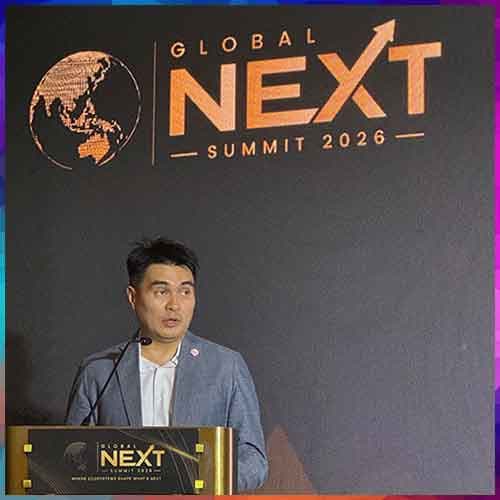
Singapore is positioning itself as a trusted base for developing, deploying and scaling artificial intelligence across Asia, as enterprises navigate an increasingly complex landscape of AI models, platforms and solutions. said Mr. Marcus Dass, SVP & Head Global Enterprise Division-Singapore Economic Development Board in Global Next Summit 2026, organised by Redington Ltd.
Under its National AI Strategy 2.0, Singapore is moving beyond experimentation toward applying AI to transform industries, improve workforce productivity and solve real-world problems at scale. Its approach combines government policy, research, regulation, investment, infrastructure and talent development to create an integrated AI ecosystem.
A major focus is on four national AI missions—Advanced Manufacturing, Connectivity, Finance and Healthcare—where AI can potentially deliver economy-wide impact. Singapore is aligning R&D priorities, regulatory frameworks and investment promotion around these sectors, with the National AI Council providing strategic direction.
The strategy is already attracting significant corporate investment. Singapore is home to more than 70 AI Centres of Excellence across multiple industries, creating an environment where enterprises can develop technologies locally and scale them into Southeast Asia—a market of around 700 million people.
Mr. Marcus Dass further said, Global companies are increasingly using Singapore for advanced AI development. Heineken, for example, established a generative AI lab in Singapore to develop agentic AI applications spanning marketing, financial reporting and customer support.
SAP Labs Singapore represents another dimension of this transformation. Established in 2022, it has evolved into a hub for agentic AI, developing autonomous systems capable of managing enterprise workflows across HR, finance and supply chains. Its expanding AI engineering presence demonstrates how Singapore's ecosystem can encourage companies to deepen their technology investments.

The country also benefits from strong digital infrastructure, a facilitative regulatory environment and access to skilled talent. Around 80 of the world's top 100 technology companies have established a presence in Singapore, while global AI leaders are expanding their research and technology capabilities.
Talent remains central to this strategy. Initiatives such as AI Singapore's AI Apprenticeship Programme provide engineers with hands-on experience solving real enterprise problems, while universities including the National University of Singapore and Nanyang Technological University strengthen the country's research and AI talent pipeline.
Redington Moves from Distributor to AI Orchestrator
The launch of Redington's AI Innovation Centre in Singapore adds an important enterprise dimension to this ecosystem. Singapore has played a significant role in Redington's journey from a technology distributor into a global technology solutions provider.
The new centre signals its next transformation—from distributor to technology orchestrator, connecting vendors, hyperscalers, partners and customers within an increasingly complex AI ecosystem says Mr. Marcus Dass.
Rather than enterprises struggling to evaluate hundreds of AI technologies independently, the centre can provide an environment to discover, evaluate, integrate, validate and accelerate AI use cases through workshops, technology partnerships and customer engagements.
This is particularly important as enterprise AI shifts toward agentic systems, where multiple models, applications, data sources and infrastructure platforms must operate together securely and reliably.
For Singapore, Redington's investment reinforces a larger ambition: becoming the place where global and regional companies build AI capabilities, test solutions, establish trusted governance frameworks and scale innovation across Asia.
Singapore's emerging proposition is therefore broader than becoming another AI development centre. It aims to become an AI orchestration and trust hub for Asia—connecting technology, talent, regulation, capital and markets to turn AI innovation into scalable economic value.