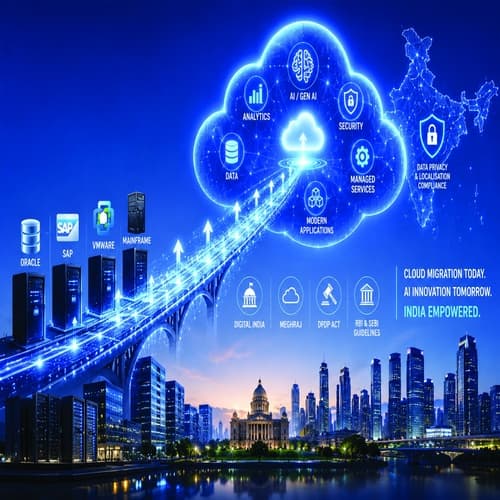
Cloud migration is undergoing a fundamental redefinition. What was once framed primarily around agility, scalability, and cost savings has evolved into a far more complex conversation spanning around AI readiness, data governance, regulatory compliance, security, and long-term business value. Across the industry, leaders from hyperscalers, infrastructure providers, systems integrators, and value-added distributors are converging on a similar conclusion: moving workloads to the cloud is no longer the finish line. It is the starting point of a much longer transformation journey.
For many organizations, the earliest barriers to migration are not technical at all. Internal alignment, change management, total cost of ownership etc., often shape the pace and direction of a cloud strategy. Once that alignment is secured, the real complexity begins to surface which involves dependencies between applications, data, and legacy systems that have accumulated over years, sometimes decades, of business logic and integration.
The emerging consensus favours a structured, phased approach: assess the environment, map dependencies, prioritize workloads based on business relevance, pilot before scaling, and continuously optimize after migration. The goal is not simply to move faster, but to move with precision.
At the same time, compliance and data governance has become a starting-point requirement. Regulatory frameworks such as India's DPDP Act, data residency and sovereignty are now shaping where workloads run and how they are governed. This has accelerated the shift toward hybrid and multi-cloud models, where sensitive workloads remain in more controlled environments while other workloads leverage the elasticity of the public cloud.
On top of this is the growing influence of AI. Organizations are increasingly recognizing that migrating a workload to the cloud does not automatically make it AI-ready. Building a strong, secure, and well-governed data foundation has become a prerequisite for scaling AI initiatives.
Migration revenue is finite; once a workload is moved, that phase of the engagement ends. The greater opportunity for enterprises and their technology partners lies in what comes next: managed services, continuous optimization, proactive security monitoring, compliance assurance, and AI-led business transformation. The organizations poised to extract the greatest value from the cloud are not those that migrate the fastest, but those that treat migration as the beginning of a continuous, outcome-driven journey.
Building AI-Ready Clouds with Governance at the core
 Mayank Chaturvedi
Hybrid Cloud Solutions Sales Leader - HPE India
HPE India’s Mayank Chaturvedi asserts that AI is changing the way organizations think about cloud migration. “A few years ago, the conversation was largely about agility, scale, and cost. Today, customers are evaluating cloud decisions through a much broader lens that includes AI readiness, data governance, regulatory compliance, security, and long-term operational control.”
“In India, we are hearing this consistently from customers. Requirements driven by the DPDP Act, RBI and SEBI guidelines, growing focus on data sovereignty, and even geopolitical considerations are influencing where data resides, how it is governed, and who ultimately controls critical technology platforms. Organizations want to innovate faster, but they also want greater visibility and control over their data and operations,” Mayank adds.
TAILORING THE RIGHT CLOUD STRATEGY
It is true that cloud migration is no longer just an IT modernization project. “Before organizations can scale AI successfully, they need a strong data foundation with the right governance, security, and accessibility built in. We are also seeing a clear shift away from one-size-fits-all cloud strategies. Data, applications, and AI workloads often have different requirements, which is why many organizations are adopting a hybrid-by-design approach,” he says.
“At HPE, we believe successful AI transformation requires the right data, the right infrastructure, and the right operating model working together. Through the GreenLake platform, we help customers modernize their cloud environment on their own terms while maintaining control, resilience, and compliance. Looking ahead, the organizations that will be best positioned for the future are those that allows data, applications, and AI to work together seamlessly while maintaining control over security, operations, and costs," he says.
Building Intelligent, Resilient enterprises on the Cloud
 Sanjeev Chauhan
Vice President, Cloud Engineering - Oracle India
Oracle India’s Sanjeev Chauhan is of the view that over the next three to five years, cloud migration will shift from being a one-time infrastructure modernization initiative to becoming a continuous business transformation journey. “The focus will no longer be on simply moving workloads to the cloud, but on continuously optimizing applications, data, and operations to improve agility, resilience, innovation, and business value,” he says. “Rather than migrating for the sake of cloud adoption, enterprises will prioritize migrations that enhance customer experiences, accelerate product development, strengthen resilience, and unlock insights from data.”
He also adds that instead of adopting a single-cloud strategy, organizations will deploy applications and data across public, private, hybrid, and multicloud environments based on business, regulatory, performance, and cost considerations. “Increasingly, the emphasis will be on bringing AI and analytics closer to where data resides, minimizing unnecessary data movement. At the same time, automation and AI will transform how migrations are planned and managed.”
PRESERVING BUSINESS CONTINUITY WHILE MIGRATING
The challenge while cloud migration is ensuring that organizations can modernize without introducing unacceptable business risk, performance degradation, compliance issues, or unplanned downtime. “The most effective approach is to make migration a business transformation initiative rather than a technology project. It starts with a comprehensive assessment to establish a clear understanding of the application landscape, dependencies, data flows, security requirements, and business criticality.”
“Equally important is executing the migration in well-defined phases. Establishing secure landing zones, automating infrastructure provisioning, validating application performance, replicating data, and building rollback and recovery into every migration wave significantly reduces operational risk,” Sanjeev explains.
Role of Cloud: Shifting from Infrastructure to adding Enterprise Value
 Venkat Sitaram
Senior Director & Country Head- Infrastructure Solutions Group - Dell Technologies India
Venkat Sitaram believes that cloud migration will become less about infrastructure transformation and more about business transformation. “The future won't belong to enterprises that simply move to the cloud—it will belong to those that build infrastructure capable of evolving with every new business and technology opportunity,” he says.
However, the hardest part in cloud migration today isn't moving workloads but modernizing them for the AI era without compromising business continuity, security or performance. “Many organizations have successfully migrated applications over the years, but they are now realizing that simply moving workloads to the cloud doesn't automatically make them AI-ready. Organizations therefore need a modern data foundation that can support both traditional enterprise applications and next-generation AI workloads, while allowing them to continuously evolve without disruptive infrastructure refreshes,” Venkat assesses.
DATA TRUST & SECURITY
As organizations accelerate cloud adoption and AI deployment, the conversation is no longer just about data security; it's about data trust. “Organizations today must navigate an increasingly complex regulatory landscape, with requirements around data privacy, sovereignty and industry-specific compliance continuing to evolve. This is prompting many enterprises to adopt a workload-first approach, where sensitive data and mission-critical applications remain in environments that provide greater control, while less-sensitive workloads leverage the scale and agility of the public cloud.”
“Successful cloud migration is built on trust. Organizations that integrate security, governance and cyber resilience into their infrastructure from the outset will be better positioned to build resilient digital businesses prepared for the future,” says Venkat.
Cloud Migration success story begins with Data Modernization
 Sudharsan Aravamuthan
Head - Systems Engineering, India - Everpure
According to Sudharsan Aravamuthan of Everpure, cloud migration will increasingly become a data modernisation journey rather than simply an infrastructure migration exercise. “As organisations move from AI experimentation to production, they will require intelligent data platforms that securely manage data across hybrid and multi-cloud environments while supporting traditional, virtualized and cloud-native applications,” he says. “Another major shift will be the growing adoption of enterprise storage platforms running natively within hyperscale cloud environments. Rather than relying solely on cloud-native storage services, organisations will increasingly seek consistent enterprise storage, protection and disaster recovery capabilities across both on-premises infrastructure and public clouds.”
MIGRATING LEGACY WORKLOADS TO THE CLOUD POSES CHALLENGES
The biggest challenge isn't moving workloads - it's modernizing without disrupting the business, is what Sudharsan believes. “The most effective approach is to focus on the data rather than the destination. Today's enterprises operate traditional applications, virtual machines, containers and AI workloads across data centres, edge locations and multiple cloud environments. Success depends on having a common data platform that delivers consistent performance, resilience, security and mobility regardless of where applications run. Equally important is adopting a cloud operating model where infrastructure is automated, policy-driven and programmable, allowing applications and data to move seamlessly across private infrastructure and hyperscale cloud environments,” he says.
NO ‘ONE-SIZE-FITS-ALL’ CLOUD STRATEGY
Sudharsan says that the right cloud mix strategy depends on workload characteristics, data sensitivity, performance requirements, regulatory obligations and business priorities. “For most organisations, hybrid cloud offers the greatest flexibility. As a result of this approach, applications benefit from consistent performance, availability, data protection and disaster recovery regardless of where they run, while IT teams manage both environments through a common operating model,” he says.
Cloud Migration evolves as a strategic business enabler for AI, analytics, and long-term growth
 Sajiv Nair
Chief Technology Officer & Chief Information Officer - ESDS Software Solution Ltd.
Cloud migration will no longer be viewed by businesses as just an IT modernization initiative but will increasingly serve as the foundation for AI adoption, data-driven decision-making, and long-term business growth, says Sajiv Nair of ESDS Software Solution. “The focus will shift towards building secure, compliant, and future-ready digital ecosystems that can scale with evolving business requirements. At the same time, intelligent automation, hybrid cloud strategies, and sovereign cloud models will see wider adoption as businesses seek greater flexibility, stronger data governance, and enhanced operational efficiency.”
CHALLENGES TO MOVING WORKLOADS TO CLOUD
The biggest challenge is not moving workloads, but it is ensuring business continuity while doing so. “Legacy applications often have complex dependencies, making downtime or data loss unacceptable,” says Sanjiv. “A successful migration therefore begins with a thorough assessment, followed by a phased, well-orchestrated approach that minimizes disruption, validates performance at every stage, and aligns technology decisions with business priorities rather than treating migration as a standalone IT exercise.”
Additionally, security and compliance should be integrated into the migration strategy from the outset, and not addressed after workloads are moved. “Organizations must choose cloud environments that provide robust encryption, strong access controls, continuous monitoring, and compliance with applicable regulatory frameworks. The right cloud strategy depends on the criticality of workloads, regulatory obligations, performance requirements, budget considerations, and long-term business objectives. For many organizations, a hybrid cloud model offers the right balance by enabling sensitive workloads to remain in a secure private environment,” Sanjiv asserts.
Redefining Cloud Migration in the AI Era
 Sachin Kotian
Head Architecture, Customer Advisory - SAS India
Sachin Kotian of SAS India commends that the cloud landscape is entering a more mature phase, going beyond simply moving workloads. “Cloud environments will increasingly serve as the foundation for real-time decision making, automation, and innovation at scale, with organizations placing greater emphasis on interoperability, governance, and responsible AI. Cloud-native analytics platforms, embedded intelligence, and AI-driven automation will help enterprises respond faster to change, improve operational efficiency, and create competitive advantage in an increasingly digital economy.”
IS MIGRATING TO CLOUD A DAUNTING TASK?
As pointed out by many, the biggest challenge to migrating workloads to cloud will be to maintain business continuity. “Legacy environments often contain complex dependencies, large data volumes, and processes that cannot tolerate disruption. A phased approach, combining data validation, application regression testing, parallel operations, and rollback planning, reduces risk and helps organizations modernize while maintaining operational stability,” says Sachin.
Sachin also adds that security and compliance should be embedded throughout the migration lifecycle. “Organizations need clear governance covering data ownership, access controls, encryption, identity management, audit requirements, and continuous monitoring. It begins with understanding what data exists, where it resides, and the regulations that apply to it. This assessment helps determine the right deployment model. Ongoing compliance monitoring, automated policy enforcement, regular security reviews, and visibility into data usage help organizations meet regulatory requirements while protecting customer trust.”
Beyond Lift-and-Shift: A Modernization-first cloud strategy
 Piyush Gupta
VP – India, APAC & Middle East - Vultr
Piyush Gupta of Vultr states that as organizations move AI initiatives from experimentation to production, they will require scalable, high-performance infrastructure capable of supporting data-intensive and GPU-powered workloads. “We also expect hybrid, multi-cloud, and distributed cloud architectures to become the norm as enterprises seek greater flexibility and resilience. Ultimately, cloud migration will no longer be viewed as an IT project - it will be a business transformation strategy that enables organizations to innovate faster, scale AI adoption, and participate more effectively in India's growing digital economy.”
MIGRATION – PART OF MODERNIZATTION STRATEGY
Piyush also asks customers to move beyond a simple lift-and-shift approach and instead view migration as part of a broader modernization strategy. “A phased approach, starting with workload assessment and prioritization helps reduce risk while ensuring applications are optimized for the cloud. By combining flexible infrastructure, predictable cloud economics, and scalable compute capabilities, organizations can modernize with confidence while building a foundation for AI, analytics, and future innovation,”
Security and compliance should be embedded into the migration strategy from day one rather than addressed after workloads have been moved. “As regulations like the DPDP Act and industry-specific requirements continue to evolve, organizations need greater visibility into where their data resides, how it is managed, and who has access to it. Enterprises should prioritize cloud platforms that offer robust security controls, encryption, identity and access management, and local infrastructure that supports data residency requirements. Beyond technology, strong governance frameworks and continuous monitoring are equally important,” he says.
Cloud migration represents India's biggest IT opportunity over the next decade
 Sonia Ahluwalia
Vice President – Cloud Practice - Kyndryl India
According to Sonia Ahluwalia of Kyndryl, businesses are entering a completely new phase of cloud adoption in India. “Cloud migration is increasingly being driven by what I see as four powerful forces shaping every boardroom discussion—AI adoption, cyber resilience, regulatory compliance and the need for continuous innovation. Today's cloud decisions are no longer about where applications run; they are about how organizations innovate faster, remain secure, comply with evolving regulations and build resilient digital businesses.”
“Banks are balancing AI innovation with RBI regulations and cyber resilience. Manufacturers are modernizing factories with AI and Industrial IoT while protecting operational technology. Healthcare organizations are digitizing patient experiences while ensuring data privacy. Government agencies are accelerating citizen services under Digital India and MeghRaj while maintaining sovereignty and trust,” she cites a few instances. Over the next five years, Sonia expects cloud migration to evolve into continuous modernization—where enterprises continuously optimize applications, data, security and operations to remain competitive in an AI-first economy. “For Indian enterprises, cloud is no longer the destination. It is the strategic platform that will enable the country's next wave of innovation, resilience and digital growth,” she states.
CHALLENGES TO CLOUD MIGRATION
“In my conversations with CIOs and CTOs across banking, manufacturing, telecom, healthcare and the public sector, the challenge they consistently describe is modernizing decades of business-critical technology without disrupting the business. The real complexity lies in understanding application interdependencies, managing operational risks and ensuring that modernization does not compromise resilience. That's why I believe cloud migration is fundamentally a business transformation initiative.”
The journey from Cloud-First to Cloud-Smart – the new Business Imperative
 Rajesh Gupta
VP & Cloud Business Head - Tata Teleservices
Rajesh Gupta of Tata Teleservices asserts that cloud migration will increasingly become AI-driven rather than infrastructure-driven. “As businesses invest in AI, automation, advanced analytics, and intelligent applications, cloud will serve as the digital foundation that enables these technologies to scale effectively. For India's MSMEs, cloud adoption will become significantly simpler through managed cloud platforms and integrated digital services. Solutions spanning IaaS, PaaS, UCaaS, CCaaS, and AI-powered business applications will increasingly be consumed as services, allowing businesses to focus less on managing technology and more on driving innovation, improving customer experiences, and accelerating growth,” he states. As businesses modernise their operations, the conversation today is no longer about being cloud-first; it is about being cloud-smart.
DATA SECURITY & COMPLIANCES
Security should be treated as a design principle, not an afterthought, says Rajesh. “As data becomes more distributed across cloud environments, organizations need consistent governance, identity management, encryption, and continuous visibility across workloads. Equally important is selecting the right cloud architecture. Different workloads have different security and compliance requirements. While customer-facing applications may benefit from the scalability of the public cloud, sensitive financial data or regulated workloads may be better suited to private or hybrid cloud environments.”
“For instance, a healthcare provider managing patient records or a financial services firm handling sensitive customer information can adopt a hybrid cloud model that keeps critical data secure while leveraging the agility of the public cloud for applications such as customer engagement and analytics. Compliance becomes significantly easier when security, governance, and cloud architecture are planned together rather than independently,” Rajesh explains.
Beyond the Move: Creating Long-Term Value in Cloud Migration
 Ranjan Chopra
Founder and CEO - Team Computers
Team Computers believes the most successful cloud journeys begin with understanding business priorities first and technology choices second, ensuring every migration creates lasting customer value.
Overcoming the Toughest Barriers in Cloud Migration
The biggest challenge isn't moving workloads to the cloud; it's ensuring they continue to deliver business value once they get there. Legacy environments often support mission-critical applications with years of business logic, complex integrations, and stringent performance and compliance requirements. Simply lifting and shifting these workloads can lead to higher costs, performance bottlenecks, and operational complexity.
At Team Computers, we begin with a workload-centric assessment rather than a cloud-first mandate. We evaluate application dependencies, data sensitivity, performance requirements, and long-term business objectives before recommending the right migration strategy. Some workloads are rehosted, others are re-platformed or modernized, while certain applications are better suited to hybrid environments. The objective is not just a successful migration, but building a cloud foundation that is secure, scalable, cost-efficient, and ready to support future innovations such as AI, automation, and advanced analytics.
Building Long-Term Customer Value Beyond Cloud Migration
Migration is the starting point, not the destination. The greatest long-term opportunity lies in helping customers continuously extract business value from their technology investments after migration is complete. Enterprises increasingly expect partners to provide proactive operations, intelligent automation, continuous security monitoring, performance optimisation, and cost governance throughout the lifecycle of their cloud environments.
At Team Computers, we are strengthening our capabilities across AI-led managed services, cloud operations, cybersecurity, digital workplace solutions, and infrastructure management. As enterprises continue their digital transformation journeys, the role of a VAR is evolving from implementation partner to long-term strategic advisor. The real opportunity is not simply enabling cloud adoption but helping customers continuously modernise, innovate, and realise measurable business outcomes from the cloud.
Modernising with Confidence, Not Just Migrating with Speed
 Gurpreet Sngh
M.D. - Arrow PC Network
Cloud migration isn't just about moving workloads anymore, it's about future-proofing the business. With AI, compliance, and data sovereignty now shaping every decision, Arrow PC Network helps enterprises modernize with confidence — not just migrate with speed.
Overcoming the Toughest Barriers in Cloud Migration
The hardest part is rarely the technology, it's the fear of disruption. Most enterprises are not worried about moving workloads; they're worried about what happens if something breaks during the move.
Our approach is simple: modernize with purpose, not urgency. We focus on assessment, dependency mapping, phased migration, and business continuity planning before moving a single workload. Cloud migration is not a "lift-and-shift" exercise anymore. It's an opportunity to eliminate technical debt, improve performance, strengthen security, and build a foundation for future innovation.
Aligning Cloud Migration with AI Adoption and Compliance Requirements
GenAI has increased the demand for scalable compute, better data management, and faster access to information. At the same time, DPDP and data localisation requirements have made governance a boardroom discussion. As a result, cloud strategy can no longer be separated from security, compliance, and data architecture. Modernization today is about building an environment where innovation and governance can coexist.
Building Long-Term Customer Value Beyond Cloud Migration
Migration opens the door, but the real value begins after the move. The biggest opportunity lies in helping customers continuously optimize, secure, and extract intelligence from their cloud environments.
At Arrow PC Network, we are positioning ourselves as a long-term transformation partner. Whether it's AI-ready infrastructure, cyber resilience, managed services, or cloud governance, our focus is on helping customers derive measurable business outcomes long after the migration project is complete. The future belongs to partners who can manage the entire technology lifecycle, not just the migration milestone.
Supertron VAD Venture Helps Enterprises Turn Cloud Migration into a Growth Opportunity
 Debraj Dam
Chief of VAD - Supertron VAD Venture
At Supertron VAD Venture, the role goes beyond enabling technology access, it's about helping customers make the right decisions at every stage of the cloud journey. From untangling complex application dependencies to aligning migration strategies with compliance and AI adoption, it brings the expertise that turns cloud migration from a risk into a growth opportunity.
Overcoming the Toughest Barriers in Cloud Migration
The biggest challenge is understanding the dependencies between applications, data, and existing systems. A direct migration may not always deliver the expected benefits. Our approach is to first assess the environment, identify dependencies, optimize workloads, and then migrate them in a planned manner. This helps reduce risks, minimize downtime, and improve overall performance.
Aligning Cloud Migration with AI Adoption and Compliance Requirements
Today, cloud migration is not only about scalability and cost savings. Compliance, data security, and data residency requirements have become equally important. We ensure that governance, security, and compliance requirements are considered from the beginning of the migration journey. This helps customers adopt new technologies, including GenAI, while maintaining compliance and protecting their data.
Building Long-Term Customer Value Beyond Cloud Migration
We see the biggest long-term opportunity in Managed Services and Cloud Optimization. Migration is the first step, but customers need ongoing support to manage performance, security, costs, and cloud resources effectively. We are focused on helping customers maximize the value of their cloud investments through continuous optimization and support services.
Intelegain Technologies Builds Recurring Customer Value Beyond Cloud Migration
 Neeraj Gargi,
CTO & Director - Intelegain Technologies
At Intelegain Technologies, cloud migration is approached as a business transformation initiative rather than a technology project. By combining structured migration planning, AI-led process transformation, and continuous security optimization, the company helps organizations reduce risk, improve operational performance, and create long-term business value beyond migration.
Overcoming the Toughest Barriers in Cloud Migration
Disruption to an established infrastructure initially brings internal challenges related to factors such as change management, TCO, and stakeholder alignment. Once buy-in is secured from internal stakeholders, organizations can begin evaluating other factors that influence the cloud migration strategy, including:
Ø Licensing complexities from OEMs related to running workloads on-premises versus in the public cloud.
Ø Regulatory compliance requirements for migrating business-critical applications to the public cloud, although most compliance frameworks support cloud adoption with appropriate adjustments to the migration strategy.
Ø System integration requirements with external applications and third-party platforms.
Ø Understanding the TCO implications when transitioning from a CAPEX to an OPEX model.
The following is an industry-proven approach as cloud migration strategy:
Discovery:
We conduct an end-to-end assessment of the existing IT landscape — legacy applications, their dependencies, and their actual relevance to current business needs. This phase is designed to answer three fundamental questions: What exists? What is being used? What can be retired?
Take Baby Steps:
We follow a repeatable, workload-by-workload framework that allows each application to move at its own pace: Discover → Assess → Prioritize → Pilot → Migrate → Optimize. Throughout this journey, the focus stays on business outcomes, not migration metrics. Success is measured by improved performance, reduced costs, stronger compliance, and tangible value delivered to the business.
Building Long-Term Customer Value Beyond Cloud Migration
The biggest long-term value creation opportunity is not in migration itself, but in the intersection of AI and security. Migration revenues are finite. Once the workload is moved, the project ends. The real opportunity is creating recurring business value after migration.
Guided AI Led Business Process Transformation
Most customers do not need another chatbot. They need measurable improvements in productivity, customer experience, revenue, compliance, and operational efficiency. Organizations should therefore begin with clearly defined business objectives rather than the technology itself, focusing on metrics such as revenue growth, customer acquisition, customer retention, employee productivity, working capital reduction, faster decision making, and compliance improvement.
Driving Cloud and Data Security
As organizations accelerate their digital transformation journeys, maintaining a strong security posture is no longer optional—it is a fundamental business requirement. For solution providers and technology partners, helping customers strengthen and continuously improve their security posture creates significant long-term business value. Security is not a one-time implementation project; it requires ongoing monitoring, optimization, policy enhancements, compliance assessments, and adaptation to an evolving threat landscape. This creates opportunities for recurring engagement through managed security services, security operations, compliance consulting, vulnerability management, and cloud security optimization.
Enabling Secure, AI-Ready Cloud Transformation
 Atul Gupta
Director - RX Infotech
As organizations accelerate cloud adoption and AI initiatives, the focus has shifted from simply moving workloads to building secure, compliant, and scalable digital environments. Lapcare supports this transition through offering premium dependable technology solutions that enables partners to build secure, productive, and future-ready digital environments
Overcoming the Toughest Barriers in Cloud Migration
Cloud migration today is no longer a technology refresh—it is a strategic business transformation. At Lapcare, we believe the biggest challenge in migrating legacy workloads such as ERP, CRM, or inventory management systems to the cloud is ensuring business continuity while preserving data integrity and security. Many organizations rely on customized legacy applications that are deeply integrated with day-to-day operations. Our approach is to adopt a phased migration strategy, beginning with a comprehensive assessment, followed by workload prioritization, rigorous testing, and secure data migration. This minimizes disruption while enabling customers to modernize their IT environment with confidence.
Aligning Cloud Migration with AI Adoption and Compliance Requirements
The rapid adoption of Generative AI, coupled with India's Digital Personal Data Protection (DPDP) Act and data localization requirements, has significantly changed how organizations plan their cloud journey. Cloud infrastructure must now be designed with security, governance, compliance, and scalability at its core. At Lapcare, we see cloud modernization as the foundation for AI-driven innovation. Organizations require secure, compliant, and high-performance infrastructure to unlock the full potential of AI, analytics, and intelligent automation. As a trusted technology brand, we support this transformation through a comprehensive portfolio of IT peripherals, networking products, storage solutions, power solutions, and enterprise accessories that enable reliable hybrid and cloud-first workplaces.
Building Long-Term Customer Value Beyond Cloud Migration
Looking beyond migration, the greatest long-term opportunity for Value-Added Resellers (VARs) and solution partners lies in delivering end-to-end managed services that combine AI enablement, cybersecurity, cloud optimization, and lifecycle support. Customers increasingly seek strategic technology partners rather than product suppliers. Our focus is to strengthen this ecosystem by providing high-quality, dependable technology solutions that empower partners to build secure, productive, and future-ready digital environments. As cloud adoption accelerates across India, we believe sustainable value will come from helping businesses continuously optimize, secure, and innovate on their cloud investments rather than viewing migration as a one-time project.