As Artificial Intelligence becomes central to enterprise operations, concerns around data security, privacy, and sovereignty are growing rapidly. Organizations increasingly rely on CPUs and GPUs to train and run AI models, processing massive volumes of sensitive information. While GPUs provide unmatched performance for AI workloads, neither CPUs nor GPUs are inherently immune to data leakage, insider threats, or cyberattacks. The key challenge is not whether data can be compromised, but how effectively organizations can minimize risk through architecture, hardware security, encryption, and operational controls.
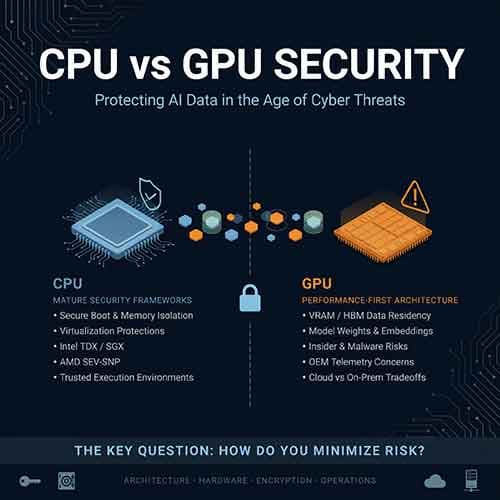
Traditionally, CPUs have been designed with mature security frameworks that include secure boot, memory isolation, virtualization protections, encryption technologies, and Trusted Execution Environments (TEEs). Technologies such as Intel TDX, Intel SGX, and AMD SEV-SNP help protect sensitive workloads from unauthorized access, even when privileged administrators or compromised hypervisors are involved.
GPUs, however, were originally engineered for performance and parallel processing rather than security isolation. AI training and inference workloads often store massive datasets, model weights, prompts, embeddings, and intermediate outputs inside GPU memory (VRAM/HBM). If improperly managed, this data can remain in memory after execution, creating opportunities for malicious insiders, malware, or advanced attackers to extract sensitive information.
A growing concern among enterprises is whether OEMs, cloud providers, or AI vendors can access customer data to improve or train their own models. The answer largely depends on deployment architecture. Public cloud AI services may collect telemetry and operational data according to contractual agreements and privacy policies. In contrast, on-premises deployments provide organizations with greater control over data residency, governance, and access management, significantly reducing exposure risks.
To address emerging threats, leading hardware manufacturers have introduced Confidential Computing technologies. NVIDIA's Confidential Computing on Hopper (H100), H200, and Blackwell GPUs protects data while it is actively being processed by encrypting GPU memory, securing CPU-GPU communications, implementing isolated execution environments, and enabling remote attestation. Combined with CPU-based confidential computing, these technologies provide end-to-end protection against many forms of insider abuse, malware, and hypervisor compromise.
However, no technology can guarantee absolute protection. Both CPU RAM and GPU VRAM remain vulnerable if attackers gain root-level privileges, exploit firmware weaknesses, conduct side-channel attacks, or obtain physical access. Therefore, organizations must adopt a defense-in-depth approach that combines encryption, memory sanitization, strict identity controls, air-gapped environments, zero-trust architectures, continuous monitoring, and regulatory compliance frameworks.
CPU vs GPU Security Comparison
| Security Aspect | CPU Architecture | GPU Architecture |
|---|---|---|
| Primary Purpose | General-purpose computing | AI, HPC, parallel processing |
| Memory Exposure | System RAM | VRAM/HBM |
| Risk of Memory Extraction | Possible with privileged access | Possible with driver/kernel access |
| Confidential Computing | Intel TDX, SGX, AMD SEV-SNP | NVIDIA Confidential Computing |
| Memory Encryption | Available on modern platforms | Available on Hopper/Blackwell GPUs |
| Secure Boot Support | Mature and widely adopted | Available on newer enterprise GPUs |
| Isolation Mechanisms | Virtualization, TEEs | MIG, Protected Compute Regions |
| Protection from Host OS | Strong with TEE support | Strong in Confidential Computing mode |
| Remote Attestation | Supported | Supported |
| Multi-Tenant Security | Mature ecosystem | Improving significantly |
| Data Sovereignty Suitability | High | High with Confidential Computing |
| AI Workload Performance | Moderate | Extremely High |
OEM Security Architecture Comparison
| OEM | Security Technologies | Key Strength |
| NVIDIA | Confidential Computing, Secure Boot, Remote Attestation, MIG Isolation | Strongest GPU security for AI workloads |
| AMD | SEV-SNP, Infinity Guard, Secure Memory Encryption | Strong CPU and AI infrastructure security |
| Intel | TDX, SGX, Trust Domain Extensions, Hardware Root of Trust | Mature enterprise-grade confidential computing |
| Apple | Secure Enclave, Unified Memory Security, Hardware Root of Trust | Highly integrated hardware-software protection |
| Qualcomm | Secure Processing Unit, Trusted Execution Environment | Strong edge and mobile AI security |
For highly regulated industries such as banking, healthcare, defense, and government, the combination of on-premises infrastructure, Confidential Computing, encryption, and strict operational controls offers the highest level of practical protection. While 100% zero data leakage can never be guaranteed, modern CPU and GPU security architectures can reduce the risk to extremely low levels, making them suitable for handling the most sensitive AI workloads and sovereign data environments.
It’s Time to FaceOff the Fact.
The real question is not CPU versus GPU performance, but whether organizations can trust the infrastructure powering AI. Despite advanced security technologies from leading OEMs, absolute protection is impossible. True resilience comes from combining trusted hardware, strong governance, encryption, and continuous monitoring to safeguard digital sovereignty.