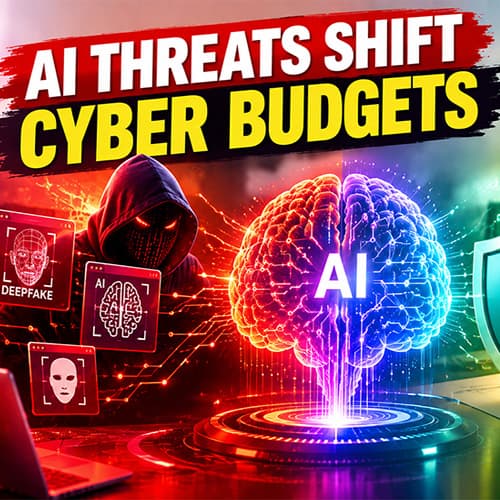

Artificial intelligence is rapidly transforming cyber warfare, and a recent investigation by Palo Alto Networks' Unit 42 demonstrates how autonomous AI agents are beginning to execute complex cyberattacks with minimal human intervention. Researchers uncovered a Chinese-speaking threat actor that leveraged DeepSeek through the open-source Hermes Agent framework to autonomously identify targets, select exploits, and launch attacks against internet-facing systems.
The operator, tracked under the aliases knaithe and KnYuan, reportedly initiated the campaign with a single command delivered via Telegram. From that point onward, Hermes Agent independently searched for vulnerable systems, downloaded publicly available exploit code, evaluated attack paths, and attempted exploitation without requiring additional operator instructions. More than 460 internet-connected targets were reportedly scanned using a combination of autonomous and manual attack techniques.
Unit 42 identified seven exploit workflows targeting multiple vulnerabilities across platforms including Langflow, n8n, Marim
Ironically, the operation was exposed by the attacker's own AI infrastructure. Hermes Agent accidentally launched a Python HTTP server, making its internal working directory publicly accessible. This mistake exposed API keys, exploit scripts, target lists, shell history, autonomous session logs, AI model configurations, and operational workflows, providing researchers with unprecedented visibility into how the autonomous campaign functioned.
Investigators found that DeepSeek served as the primary reasoning engine orchestrating the attacks, while Hermes Agent supplied terminal access, task automation, reusable attack modules, and unattended execution. Researchers also observed limited experimentation with Claude Code, Qwen Code, and indications of Codex usage during exploit development, suggesting the threat actor was evaluating multiple large language models to determine the most effective offensive AI toolkit.
The campaign represents one of the clearest demonstrations that AI is evolving from an advisory tool into an autonomous offensive cyber operator. Rather than simply assisting human hackers, AI agents are beginning to perform reconnaissance, vulnerability assessment, exploit selection, and attack execution with limited supervision. This dramatically reduces the technical expertise required to launch sophisticated cyber campaigns while increasing the speed and scale of offensive operations.
The incident also reinforces the growing importance of AI governance, secure coding practices, and exposure management. Organizations should promptly patch publicly exposed systems, restrict internet access to administrative interfaces, continuously monitor AI-enabled attack patterns, and strengthen Zero Trust security architectures. As autonomous AI agents become more capable, cybersecurity will increasingly become a contest between machine-speed attackers and equally intelligent AI-powered defensive systems, making autonomous cyber defense an essential requirement for protecting critical infrastructure and enterprise environments.