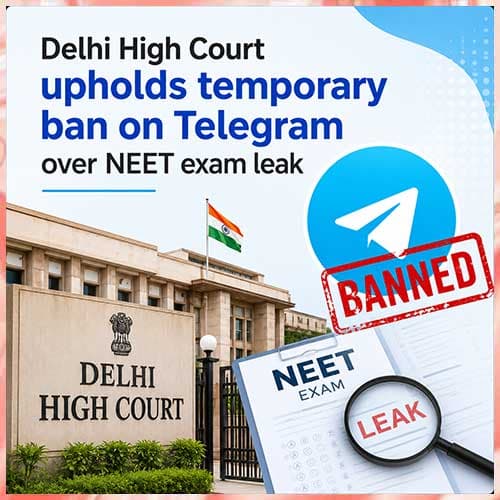
A Delhi High Court on Friday upheld the Indian government's temporary ban on Telegram, ruling that authorities acted lawfully in blocking the messaging platform for a week to protect the integrity of a national medical entrance examination after allegations of question paper leaks.
Justice Tejas Karia dismissed Telegram's challenge, holding that the government was empowered under existing laws to restrict public access to the platform in the interest of preserving the examination process.
The government ordered internet service providers and app stores to block Telegram from June 16 to June 22 after the results of the country's medical entrance examination were cancelled amid claims that question papers had been leaked and circulated through messaging channels.
The ruling marks a significant victory for the government in its efforts to curb the spread of leaked examination material but has also reignited concerns over the scope of executive powers to block digital platforms.
Digital rights advocates argued that the decision could create a precedent allowing authorities to suspend access to messaging services whenever they consider them a public risk.
"The ruling sets a concerning precedent with consequences for the open internet that extend well beyond this case," the Internet Freedom Foundation said in a statement following the verdict.
The government maintained that Telegram posed unique enforcement challenges compared with other messaging platforms, citing features that allow blocked channels to be recreated quickly and enable users to conceal identities through usernames instead of phone numbers.
According to court filings, these capabilities made it difficult to prevent the continued circulation of leaked examination material and justified the temporary restriction.
Telegram, which counts India as its largest market with more than 150 million users, argued that it had proactively removed unlawful content and accused the government of failing to acknowledge those efforts. The company said it had taken down more than 900 links related to leaked examination material.
Founder Pavel Durov has also criticized the ban, arguing that it penalizes millions of legitimate users while the distribution of leaked content simply shifts to other platforms.
The temporary suspension was implemented within hours by telecom operators and app store providers, including Google and Apple, making it one of the most high-profile legal confrontations between a global technology platform and the Indian government this year.
The dispute follows reports that government officials had privately urged Telegram to take stronger action against accounts allegedly distributing leaked examination papers before resorting to the temporary ban.
The case is likely to be closely watched by technology companies and digital rights groups, as it raises broader questions about platform responsibility, government powers to restrict online services, and the balance between public interest and digital freedoms.
Justice Tejas Karia dismissed Telegram's challenge, holding that the government was empowered under existing laws to restrict public access to the platform in the interest of preserving the examination process.
The government ordered internet service providers and app stores to block Telegram from June 16 to June 22 after the results of the country's medical entrance examination were cancelled amid claims that question papers had been leaked and circulated through messaging channels.
The ruling marks a significant victory for the government in its efforts to curb the spread of leaked examination material but has also reignited concerns over the scope of executive powers to block digital platforms.
Digital rights advocates argued that the decision could create a precedent allowing authorities to suspend access to messaging services whenever they consider them a public risk.
"The ruling sets a concerning precedent with consequences for the open internet that extend well beyond this case," the Internet Freedom Foundation said in a statement following the verdict.
The government maintained that Telegram posed unique enforcement challenges compared with other messaging platforms, citing features that allow blocked channels to be recreated quickly and enable users to conceal identities through usernames instead of phone numbers.
According to court filings, these capabilities made it difficult to prevent the continued circulation of leaked examination material and justified the temporary restriction.
Telegram, which counts India as its largest market with more than 150 million users, argued that it had proactively removed unlawful content and accused the government of failing to acknowledge those efforts. The company said it had taken down more than 900 links related to leaked examination material.
Founder Pavel Durov has also criticized the ban, arguing that it penalizes millions of legitimate users while the distribution of leaked content simply shifts to other platforms.
The temporary suspension was implemented within hours by telecom operators and app store providers, including Google and Apple, making it one of the most high-profile legal confrontations between a global technology platform and the Indian government this year.
The dispute follows reports that government officials had privately urged Telegram to take stronger action against accounts allegedly distributing leaked examination papers before resorting to the temporary ban.
The case is likely to be closely watched by technology companies and digital rights groups, as it raises broader questions about platform responsibility, government powers to restrict online services, and the balance between public interest and digital freedoms.