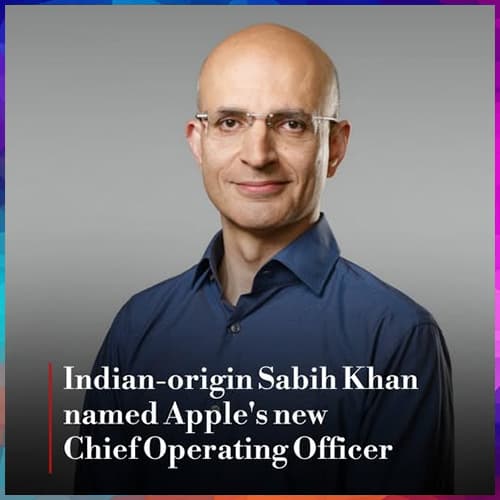
Apple’s elevation of Sabih Khan as Chief Operating Officer represents more than a leadership transition. The Indian-origin executive, born in Moradabad, Uttar Pradesh, succeeded longtime COO Jeff Williams in July 2025, putting him at the centre of one of the world’s most sophisticated technology supply chains.
Khan joined Apple in 1995 and spent decades building expertise across procurement, manufacturing, logistics and supplier management. Long before Apple became synonymous with the iPhone, he was helping create the operational machinery capable of manufacturing hundreds of millions of devices globally.
His promotion matters particularly as Apple restructures its supply chain. Geopolitical tensions, tariffs and concentration risks are pushing global technology companies to diversify manufacturing beyond China. India is becoming increasingly important to Apple’s production strategy, making Khan’s operational experience particularly valuable.
Khan has also played an important role in Apple’s environmental and supplier-responsibility initiatives. Modern supply-chain leadership is no longer simply about producing devices efficiently—it increasingly involves decarbonisation, renewable energy, responsible sourcing, labour standards and resilience.
The bigger strategic question is how operations will evolve in the AI era. Apple must integrate increasingly powerful chips, AI capabilities and new hardware architectures while maintaining its traditional strengths in privacy, performance and tightly integrated devices. Khan’s ability to translate ambitious product strategies into manufacturing at enormous scale could therefore become crucial.
His journey from Moradabad to Cupertino also reflects India’s growing influence across global technology leadership. Yet Khan’s significance goes beyond his origins. As AI, geopolitics and supply-chain restructuring transform the technology industry, Apple needs operational excellence as much as product innovation. Tim Cook may define Apple’s direction, but Sabih Khan will increasingly determine how efficiently that vision becomes reality.