

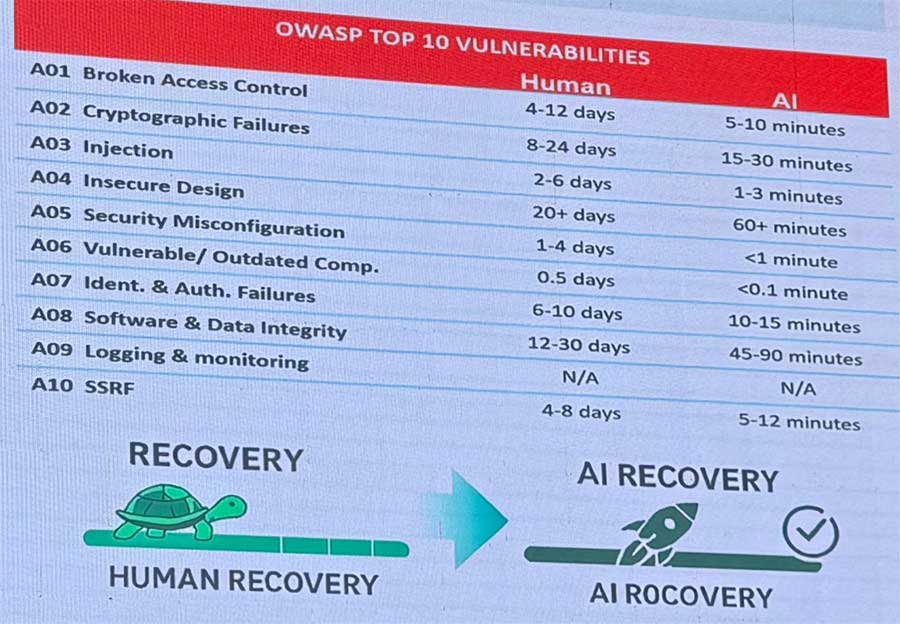
The cybersecurity landscape is undergoing a fundamental transformation as traditional detection methods prove inadequate against the speed of AI-powered adversaries. Historically, the industry has focused on detecting threats and responding to them, but this approach is increasingly ineffective. For instance, vulnerabilities like Broken Access Control can take humans 4–12 days to patch, while AI attackers can exploit them in mere minutes. This stark contrast highlights an urgent need for a revolutionary shift in defense strategies.
|
Category |
Traditional Approach |
OPSWAT's Prevention-First Approach |
|
Threat Detection Method |
Detect and respond |
Eliminate threats before they reach the user |
|
Speed of Threat Response |
4-12 days for patching vulnerabilities |
5-10 minutes for AI adversaries |
|
Vulnerability Examples |
Broken Access Control, Security Misconfiguration |
Zero-Day Exploits, AI-Generated Phishing |
|
Phishing Characteristics |
Poor spelling and grammar |
Highly personalized, grammatically correct |
|
Phishing Email Stats |
Historical reliance on detectable patterns |
56% of phishing emails expected to be AI-assisted by 2025 |
|
File Handling |
Read files to check if they are malicious |
Deep Content Disarm and Reconstruction (Deep CDR) |
|
File Processing |
Manual checks and potential bottlenecks |
Automated, sanitized file delivery |
|
Detection Engines Used |
Single detection engine |
30+ anti-malware engines for community defense |
|
Detection Rate |
Standard detection rates |
Up to 99.2% detection rate with collaborative AI |
|
Zero-Day Efficacy |
Limited effectiveness against zero-days |
99.9% efficacy with MetaDefender Aether |
|
Case Study Result |
Struggled with outdated systems |
Nearly 100% reduction in email threats |
OPSWAT is at the forefront of this revolution with its "Prevention-First" architecture. By moving away from reliance on detection, OPSWAT aims to eliminate threats before they can reach users. In an era where social engineering attacks—especially phishing—are becoming more sophisticated and difficult to detect, this proactive stance is crucial. With AI-generated phishing emails expected to dominate 56% of reported attacks by 2025, the challenge is formidable.
The rise of the "impossible" phish emphasizes the urgency of OPSWAT's approach. Today’s phishing attempts are highly personalized and often indistinguishable from legitimate communications. Traditional security measures that rely on detecting known threats fail against adversaries capable of creating new, undetectable attacks in real time.
To combat this, OPSWAT utilizes its Deep Content Disarm and Reconstruction (Deep CDR) technology, which fundamentally rethinks file handling. Instead of merely scanning for threats, Deep CDR disassembles files into their basic components, removes any potentially harmful elements, and rebuilds them into safe, functional versions. This eliminates the risk of polymorphic malware, ensuring that users receive clean files every time.
In conjunction with Deep CDR, OPSWAT’s Multiscanning feature employs over 30 anti-malware engines to enhance threat detection. This collaborative approach increases detection rates to 99.2%, allowing for swift responses to emerging threats without the delay characteristic of traditional methods. The platform's efficiency significantly reduces the time needed for remediation.
Recent success stories, such as with Hapool Insurance, illustrate the effectiveness of OPSWAT’s solutions. After adopting MetaDefender Email Security, the company nearly eliminated email threats and reduced manual IT intervention, achieving near-zero threat incidents. This underscores the power of a prevention-first architecture in combating advanced social engineering tactics.
In conclusion, as AI continues to shape the cybersecurity battlefield, OPSWAT’s innovative strategies provide a robust defense against the evolving threat landscape. By prioritizing prevention over detection, OPSWAT is not just adapting to the challenges posed by AI adversaries but redefining how organizations can protect themselves in a rapidly changing environment.